Last updated 31 October 2026
What does AI actually do in a recruitment agency?
Most of a recruiter's day is people work: calls with candidates, briefs with clients, interviews and offers. Around every one of those conversations sits admin. Someone writes up the notes, updates the record, sends the follow-up, formats the resume, pulls together the client report and, at the end, raises the invoice. None of it is hard. It is constant, and it falls behind the moment the desk gets busy.
AI is now good at exactly this kind of work. It can read a meeting and pull out the actions, draft a follow-up in the right tone, keep a record current from what was said, and assemble a document from information the agency already holds. The judgement stays with the recruiter. The typing, copying and chasing move to the system. If you want the detail on the first of those jobs, read can AI take meeting notes.
Which recruitment jobs does Seby take off your desk?
Seby is one brain with engines on top. Each engine runs one slice of the back office, and you switch on the ones you need. For a recruitment agency, these are the ones that matter most.
Meetings engine
Every call written up by morning
Candidate and client meetings recorded, classified and debriefed by morning, with the actions pulled out and assigned.
Comms engine
Follow-ups in your voice
Inbox triaged, replies drafted in your voice, and follow-ups written from your meetings. Nothing sends without your say-so.
Customer engine
Records that keep themselves
Every lead and customer captured and kept fresh on its own, with the contact history in one place. No manual entry.
Proposal engine
Proposals and client decks
A brief goes in, the research gets done, and a branded proposal or deck comes out, with e-signature built in.
Billing engine
Invoices out, payments chased
The moment a deal is signed, the invoice goes out, the payment link is sent, and it chases until you're paid.
Reporting engine
Reports without the blank page
Leadership briefs and dashboards written before the meeting, from the sources you connect.
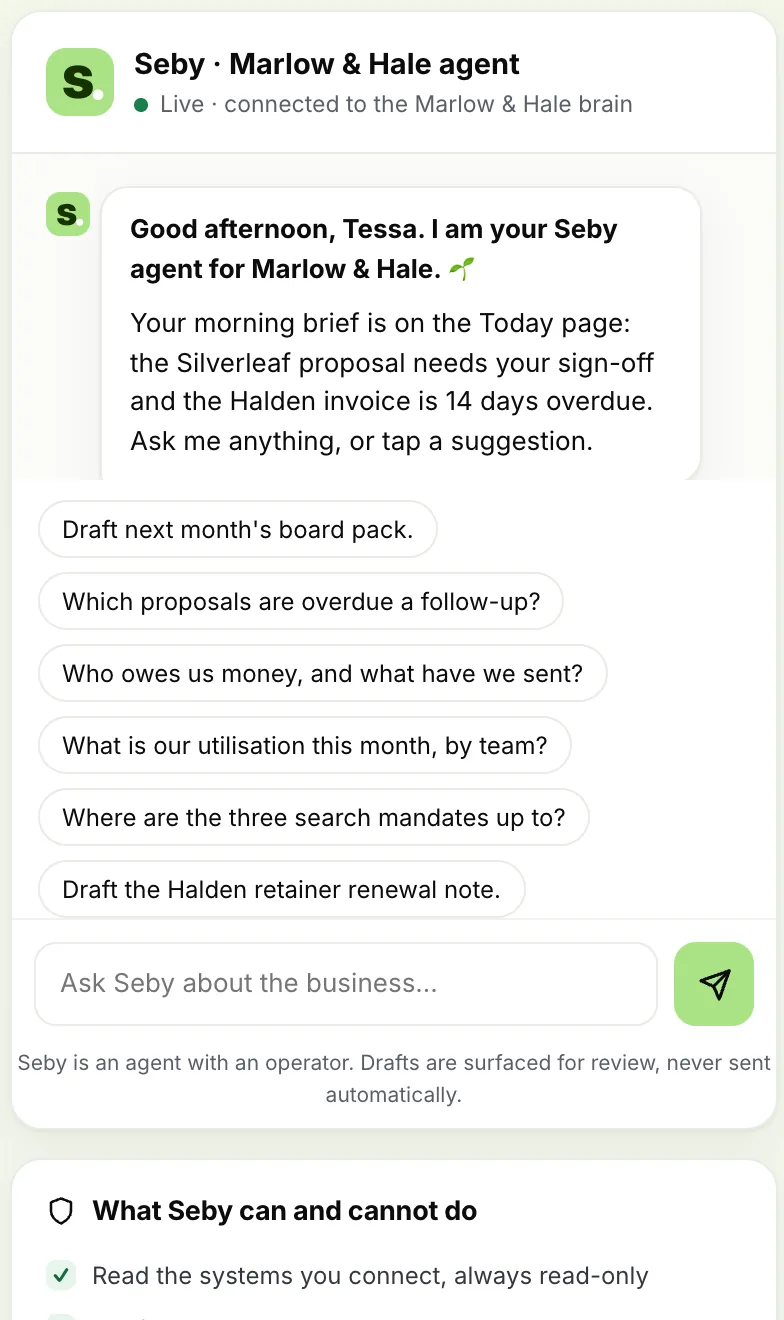
Underneath them all, the agent sits in your Teams or Slack. A recruiter can ask where a search is up to, or who has not been followed up, and get an answer with the source. See every engine.
What changed at HuddleTalent?
Cliff Wilson owns HuddleTalent, an HR services and recruitment firm in Sydney with a team of four. Before Seby, the team worked across eight to ten systems. In his words: "There was a lot of manual administration work around preparing client reporting, or formatting resumes, or looking up content to populate those reports."
"Now the proposals pretty much write themselves."
 Cliff Wilson
Owner, HuddleTalent. HR services and recruitment, Sydney
Four months in, Cliff estimates Seby has replaced about eight tools. The conversations in their sales meetings now update the pipeline and move things along its stages. Watch Cliff tell it himself.
Does it work with the tools your agency already uses?
Yes. Nothing gets replaced. The agent lives where your team already talks, so nobody has to log in to a new tool. Seby connects to what you already run:
- Microsoft 365: Outlook, Teams, SharePoint, OneDrive
- Google Workspace: Gmail, Calendar, Drive
- Slack
- HubSpot, Salesforce, Notion and Dropbox
- Your meeting recorder
- Specialist tools, scoped per integration
If your agency runs a specialist recruitment system, that is a custom integration. We scope it on a call and quote it per tool. The full list is on how it works.
What stays with your recruiters?
The relationships, the judgement and the decisions. Seby drafts and your people approve. Nothing goes to a candidate or a client without a named person's approval, and every question and answer is kept in an audit log. Your agency gets its own brain on a machine dedicated to you, and your data never reaches another business. The detail is on the trust page.
How long does it take, and what does it cost?
Weeks 1 to 2 are an audit and plan: we sit inside your inbox, meetings and systems and map where the week actually goes. Weeks 3 to 12 are the build and install. In months 4 to 6 we run it alongside your team, then hand over with your own operator trained. A single engine can be running in weeks.
Every plan includes the Brain. Front Office is the full sales trail, from lead to invoice. Priced in USD, billed monthly. No lock-in. See pricing for every plan, Seby Billing if invoicing is the first job you want gone, and our guide on what AI back office automation costs.
Questions recruitment agency owners ask
What can AI do for a recruitment agency?
It can take the admin around candidates and clients: writing up meetings, drafting follow-ups in your voice, keeping records of every person and deal current, building proposals and client reports, and sending invoices. With Seby, a person approves anything before it goes out.
Will Seby replace our recruitment CRM?
No. Seby runs on top of the tools you already use and does not replace them. It connects to Microsoft 365, Google Workspace, Slack, HubSpot, Salesforce and more. A specialist recruitment system is a custom integration that we scope and quote per tool.
Does anything go to a candidate or client without us seeing it?
No. Nothing sends without your say-so. Every draft comes to you first, and the agent keeps a full audit log of every question and answer.
How long before it is running?
A single engine can be running in weeks. The full operating system is deployed inside your firm in 12 weeks, with handover to your own trained operator by month six.
What does it cost?
Plans start from US$1,999/mo for a single engine, with the Brain included. Priced in USD, billed monthly. No lock-in, cancel anytime.
Is a recruitment firm already using Seby?
Yes. Cliff Wilson, owner of HuddleTalent, an HR services and recruitment firm in Sydney, runs his team of four on Seby. Four months in, he estimates it has replaced about eight tools.