A company brain is an AI system that reads what comes into a business, such as email, meetings and files, keeps a lasting memory of it, and uses that memory to answer questions and do work for the whole team. It is also called an AI business brain or a shared brain. Unlike a chatbot, it does not start from nothing each time: it already knows your people, your clients and your deals.
It does three things in a loop. It reads what comes in: the email threads, the meeting recordings, the documents and the records in the systems you connect. It remembers all of it, so the history of every client, deal and decision sits in one place rather than in five tools and three people's heads. Then it works out what matters and does the work: answering a question, drafting a reply, writing up a meeting, building a report.
The point is not storage. Most businesses already have their information stored somewhere. The point is that the brain can use it, for anyone on the team, without someone first finding the right file and reading it.
How does Seby's shared brain work?
At Seby we call it the Brain. It is the always-on intelligence layer every engine plugs into. It reads your email, meetings and documents, keeps a living memory of your business across privacy tiers, and decides what each engine needs to know. It comes with every plan.
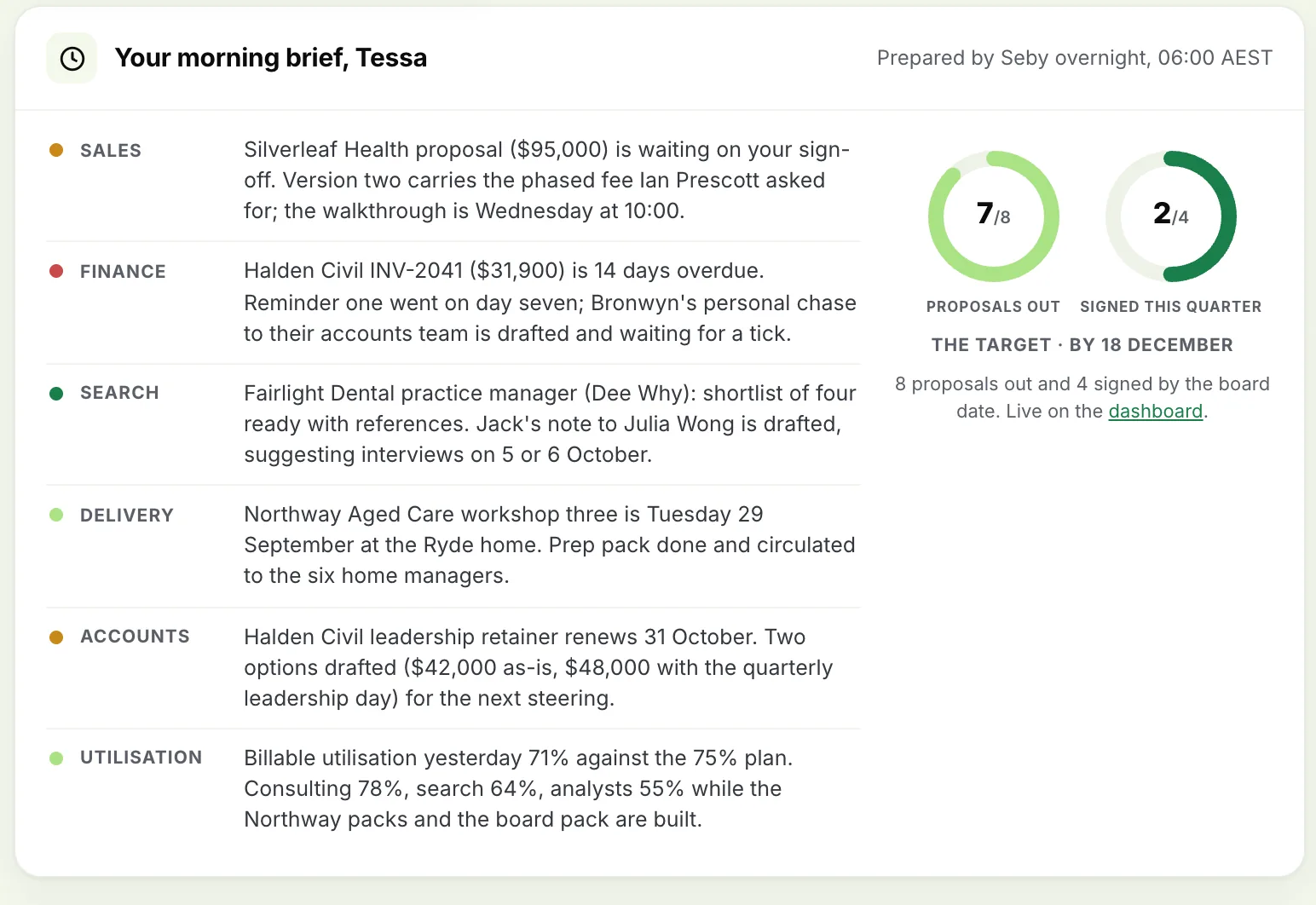
The morning brief the brain writes overnight. Marlow & Hale is a fictional firm we built to show the product.
On top of it sit engines, each one a slice of the back office that runs itself: proposals, customers, billing, finance, comms, meetings, content and reporting. You talk to it through an agent in Teams, in Slack or in the command centre, and it answers with the source. Each morning it writes a brief from your inbox, your meetings and every system you connect, and it lands before 7am. We install it in consultancies, recruitment agencies and construction firms.
Seby's shared brain
One brain the whole firm works inside.
It reads what comes in, remembers all of it, works out what matters, then does the work.
Reads your email
Reads your meetings
Reads your files
seby.
Remembers every person and deal
Works for your whole team
Drafts replies
Reminds you before deadlines
Books and schedules
Your business gets its own brain. Nothing goes out without your OK, and your data never reaches another business.
A general chatbot is a conversation. You paste in some context, ask a question and get an answer. Some chat tools now keep a little memory between conversations, but they still only know what someone has typed or uploaded. They do not know who your clients are, what was agreed last Tuesday, or which invoice is late, unless you tell them.
A company brain is connected to the business itself. It has already read the thread, the meeting and the proposal, so a question like "who owes us money, and what have we sent?" has a real answer. Cliff Wilson, who runs HuddleTalent on Seby, put the difference this way:
"It isn't about the most recent note or most recent data content. It's about what is relevant to what you're trying to do."
How is it different from a search tool?
Search finds documents. You type a term, get a list of files, and then you read them, work out what matters and do the work yourself. That is useful, but the reading and the doing are still yours.
A company brain goes further. It connects the people, deals and meetings across those documents, tells you what needs attention, and drafts the next step: the follow-up, the invoice, the board pack. A person still approves anything that goes out. Search answers "where is it?". A brain answers "what should happen next?" and starts on it.
When does a business need a company brain?
Usually when the business has outgrown one person's memory. These are the common signs:
Information is spread across many tools, and nobody uses them the same way.
People ask each other what was said in a meeting, because the notes live in someone's head.
The owner is the only person who knows where every client and deal is up to.
Proposals, reports and follow-ups are rebuilt from scratch each time.
New staff take a long time to pick up the history of each client.
If two or three of these sound familiar, the problem is rarely effort. It is that the business has no shared memory. Before Seby, Cliff's team worked across eight to ten systems. Now, when someone cannot remember what was said in a meeting, in his words: "You just ask Seby, and Seby will give you that context."
What should you check before you trust one?
A company brain reads a lot of sensitive material, so ask four questions of any provider. Here is how Seby answers them.
Question
Seby's answer
Where does it run?
Seby runs your brain on a machine dedicated to you, in your region, one tenant per machine.
Is your data used to train models?
Never. Your prompts and documents are never used to train any model.
Can you leave with it?
Yes. The memory is plain files and a standard database (Markdown, SQLite, git). If you end the engagement, you keep the brain.
What can it send on its own?
Nothing external. Nothing sends without your say-so, and every question and answer is logged.
The full detail on hosting, residency and the model layer is on the trust page.
What does a company brain cost with Seby?
The Brain comes with every plan; the difference is how many engines run on it. Plans start from US$1,999/mo for a single engine. Priced in USD, billed monthly. No lock-in. See pricing for every plan, our guide on what AI back office automation costs, and how it works for the install, from audit to handover.
FAQ
What is a company brain in AI?
A company brain is an AI system that reads what comes into a business, such as email, meetings and files, keeps a lasting memory of it, and uses that memory to answer questions and do work for the whole team. It is also called an AI business brain or a shared brain.
Is a company brain the same as a knowledge base?
No. A knowledge base holds documents that someone writes and keeps up to date. A company brain reads what comes in on its own and keeps its memory current without anyone filing it. It also does work, such as drafting replies and reports, rather than only storing answers.
Does a company brain replace our existing software?
Not with Seby. It runs on top of the tools you already use, such as Microsoft 365, Google Workspace, Slack and Xero, without replacing any of them. The agent lives where your team already talks.
Is our data safe in a company brain?
With Seby, your brain runs on a machine dedicated to you, with its own memory and credentials. Your data is never used to train any model, is never pooled with another customer, and every question and answer is kept in an audit log.
How long does it take to set one up?
With Seby, a single engine can be running in weeks. The full operating system is deployed inside your firm in 12 weeks, with handover to your own trained operator by month six.
What does a company brain cost?
With Seby, the Brain is included in every plan. Plans start from US$1,999/mo for a single engine. Priced in USD, billed monthly.
See a company brain on your own business.
Book a call. We look at where your week goes, tell you which job to hand the brain first, and what it costs. Then you decide.